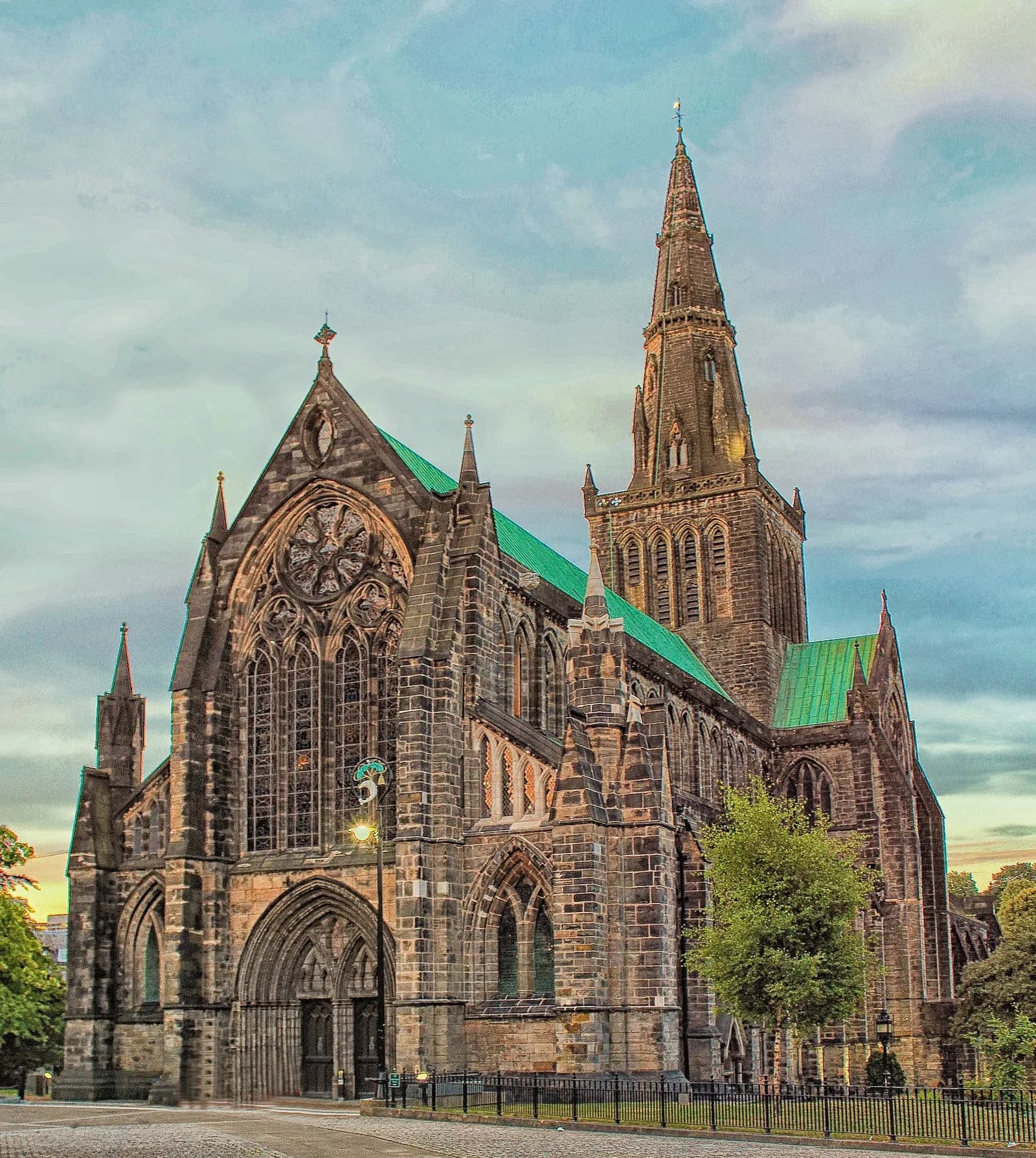
Glasgow Cathedral is the oldest building in the city and the most complete medieval cathedral on the Scottish mainland. Its survival through the upheavals of the Protestant Reformation owes as much to civic intervention as to the strength of its Gothic stonework.
Origins on the Banks of the Molendinar
The cathedral's history is inseparable from that of Glasgow itself. The site has been revered since the time of Saint Kentigern, better known as St Mungo, the city's patron saint, whose tomb lies in the Lower Church. The first stone cathedral was built during the 1100s and consecrated in 1136. The present structure was dedicated in 1197, though much of what visitors see today dates from a major rebuilding programme that began in the 13th century. Construction continued in phases over approximately 350 years. The building also served as an early seat of learning; the University of Glasgow held its first classes in the cathedral's chapter house following its foundation in 1451.
Architecture That Outlasted an Era
The cathedral is a rare example of Scottish Gothic architecture. The Lower Church, or crypt, was built in the mid-1200s to house St Mungo's tomb, and remains one of its most significant spaces. A richly carved stone screen, known as the pulpitum, was added between the choir and nave in the early 1400s. Unlike nearly every other medieval cathedral on the Scottish mainland, Glasgow Cathedral survived the Reformation of 1560 with its roof intact. That physical continuity makes it an exceptional survivor of a period that saw widespread destruction or adaptation of Scotland's pre-Reformation churches.
Spared by the Town Council
The precise reasons for the cathedral's preservation involve both royal and municipal action. Records indicate that on 22 April 1581, James VI granted to the town of Glasgow the income from several lands to support the kirk's upkeep. The king traced these lands to a legacy left by Archbishop Gavin Dunbar for repairing the cathedral. On 27 February 1583, the Glasgow town council agreed to assume responsibility for maintaining the building, whilst noting that it had no formal obligation to do so. Historians credit this resolution with securing the church's future.
A Working Church in Modern Glasgow
Today, Glasgow Cathedral functions both as a working parish church within the Church of Scotland and as one of the city's most significant historical attractions. It stands at Cathedral Precinct on Castle Street, overlooking the Glasgow Necropolis and adjacent to the Glasgow Royal Infirmary. Entry is free, though donations support the building's upkeep. Volunteer guides offer free tours six days a week, and the cathedral hosts regular musical events and concerts. Historic Environment Scotland cares for the property, which remains Crown-owned. In June 2025, new stained glass windows, entitled the Glasgow 850 Windows, were unveiled as the latest addition to a building that has witnessed nearly nine centuries of the city's history.